
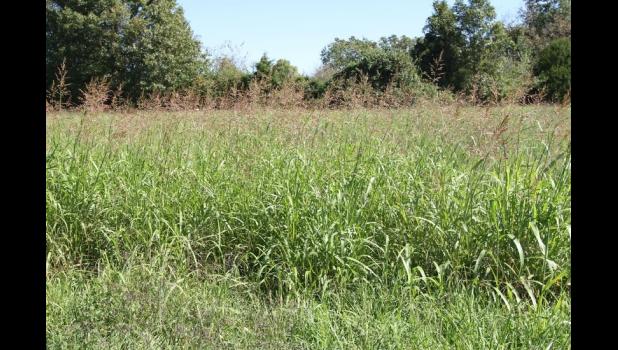
Johnsongrass – Is it safe to feed to cattle?
Tue, 08/19/2025 - 1:39pm
admin
Due to the abnormally dry conditions, we have been getting several calls about high nitrates in Johnsongrass. We can test your Johnsongrass or Sorghum-Sudan at our extension offices for nitrate. Bring 3-5 handfuls of grass clipped at the soil surface from random areas of your field. The test only takes a few minutes and brings some peace of mind as we continue to get dryer in south-central Missouri.
Johnsongrass (Sorghum halepense) is a warm-season perennial rhizomatous grass found throughout Missouri. Historically, Johnsongrass was introduced as a forage crop in the Blackbelt region of Alabama in 1840. However, it rapidly spread along the roadsides and into annual crops and hay fields, becoming a very troublesome weed. We often have a love/hate relationship with Johnsongrass. It is great for cattle grazing until it becomes stressed. However, it is easy to graze it out with continuous grazing. It also makes a good hay crop, but only if you can cure it.
Here are several frequently asked questions concerning Johnsongrass in pastures and hayfields:
Is Johnsongrass good for grazing?
Yes, if you are grazing cattle. It can be a high-quality forage and cattle will readily select vegetative Johnsongrass in pastures and graze it. In fact, in continuously grazed pastures, cattle will quickly overgraze and eliminate a johnsongrass stand within a few years. However, the answer is no when Johnsongrass becomes stressed by drought or frost. Stress results in accumulation of prussic acid (cyanide) in the leaves, which is lethal to grazing animals. Johnsongrass may also accumulate nitrates to toxic levels in these situations, creating a dual threat. The answer is also no if you are grazing horses. Johnsongrass is closely related to several other forage sorghums and should not be grazed by horses as it can lead to equine cystitis.
How soon can I graze Johnsongrass after a drought has ended or after frost?
It is important to wait at least five days after good rainfall has occurred. It is recommended that standing Johnsongrass forage killed by frost should be avoided for a minimum of two weeks after the killing frost.
Does stressed Johnsongrass hay retain toxic levels of prussic acid? Is it still poisonous if fed in hay?
No, the toxin does not persist in hay that has been properly cured. Prussic acid levels elevate due to stress and deteriorate over time. Johnsongrass with high prussic acid levels can be ensiled or harvested for hay with little fear of poisoning when fed.
Does stressed Johnsongrass hay retain toxic levels of nitrates? Is it still poisonous if fed in hay?
Yes, nitrates do not degrade naturally over time and hay containing high levels of nitrates can pose a risk even after a significant storage period. If you are concerned about potentially toxic levels of nitrates in harvested forage, bring a sample into your local extension office for free nitrate testing. Nitrate toxicity occurs rapidly and often affects several animals simultaneously that are ingesting the same hay.
Are there other problems in hayfields?
Besides the toxicity issues, the aggressive growth of Johnsongrass can outcompete tall fescue, native grasses, and warm-season annual grass, leaving dense patches throughout hayfields. The culm (clump) thickness may also result in curing and quality problems, especially for horse hay producers.
Can mowing alone control Johnsongrass?
Johnsongrass is intolerant of frequent mowing. However, it will persist with a single cutting, so do not expect good control from cutting alone in most hay operations. Johnsongrass rhizomes store significant energy, which allows for rapid regrowth following cutting.
What about biological controls?
There are no classical biocontrols (insects or pathogens) approved for release on Johnsongrass. However, as previously discussed, grazing will strongly suppress and eventually eliminate Johnsongrass.
What herbicides can be used to control Johnsongrass?
In tall fescue, there are no selective herbicides for post-emergent Johnsongrass control. Glyphosate can be spot applied or selectively applied through a ropewick or rotowiper type applicator. This technique requires a good height difference between the forage grass and Johnsongrass and at least two application passes (back and forth, or perpendicular) to get good coverage. This method misses seedling Johnsongrass that is too short to receive the herbicide treatment. In warm season grasses, there are four main herbicide options:
1. Outrider or Maverick (Sulfosulfuron). Apply at 1.33 oz/A, or as a spot treatment (1.33 oz/100 gallons of water). Add a nonionic surfactant at 0.25% v/v (1 quart per 100 gallons of spray mix) to either foliar treatment. Apply from 18 inches to bloom. This can be safely used on established bermudagrass and Warm-season native grasses, this is more effective in September.
2. Pastora (Nicosulfuron + Metsulfuron). Apply at 1.5 oz/A + a nonionic surfactant at 0.25% v/v (1 quart per 100 gallons of spray mix) as a broadcast treatment within 5-10 days after hay harvest to actively growing Johnsongrass, but before bermudagrass regrowth starts. This treatment timing may still result in a temporary yellowing of new bermudagrass growth, but yields should not be reduced at next cutting. This treatment can only be used on established bermudagrass.
3. Roundup Powermax or generics (Glyphosate). In coastal bermudagrass, glyphosate can be used as a post-emergent treatment to control newly emerged seedling Johnsongrass just after hay cutting, but before bermudagrass initiates new growth. This treatment can only be used on established bermudagrass.
4. Prowl H2O (pendimethalin). In established warm season grasses, there is one option for preemergent (seedling Johnsongrass) control. Prowl H2O can only be applied during dormant period. This treatment can be used on established warm-season forage grasses or to prevent new seedlings in the spring on established cool-season grasses with at least 6 tillers. Rate depends on soil type.