
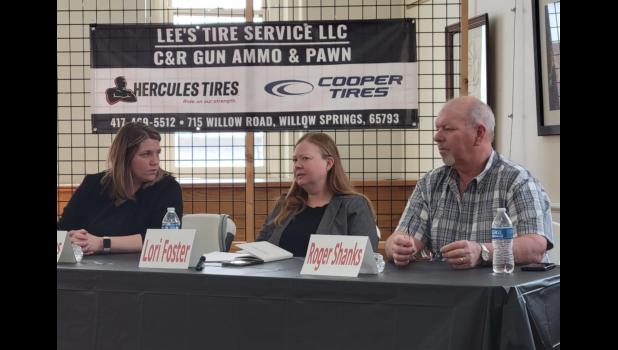
At forum, candidates chew over spending, teacher turnover, nepotism
Tue, 04/01/2025 - 11:55am
admin
By:
Amanda Mendez, publisher
The names of three Willow Springs High School alums are on the ballot, and voters will choose two to serve on the board. Meagan Jones, Lori Foster (Logan), and Roger Shanks participated in a voter’s forum Thursday night in the upstairs of the Ferguson Building in downtown Willow Springs.
Teacher retention was a recurring theme, and each of the candidates touched on it in their opening statements.
Jones, a mother two students currently enrolled in the district, said, “My goal is to make sure that we're retaining very good teachers and staff members and make it a good place for our students. To give them the best education so that they can go on and be productive in society and give back to community.”
Shanks, a father of two Willow Bears, opened, “I want to make sure that we retain good teachers. And I want to prepare students with the future. There's a lot facing them nowadays. A lot of new things that are thrown out all the time, and I want to make sure they're prepared academically and emotionally prepared to work. We also need to work on budget for school.”
Foster (Logan) spoke about her experience employing high school students, “I have a lot of graduates from Willow that are employed, and I have high school students. I've seen the gamut of what the education that they've experienced, and I do feel like that there's a strong opportunity to continue to improve that… because 40 percent plus of the students that are graduating are going to full-time employment… I also believe that it's important that we do get great Educators that believe in, you know, multifaceted education from Willow and encourage those students to achieve the greater goals that they might have in life.”
Willow Springs icon Wendell Bailey asked the first question of the night, “What is the most important thing that needs to be accomplished in the position you are seeking?”
Shanks reiterated his budget concerns, “We've got to work within our means at the school. We've got to balance that, but we also need to keep and retain quality people.”
Foster (Logan), took a different tack and answered, “Advocacy for students. You know, our students are, a high percentage of them, greater than 50, that are not proficient in the basic reading and math. We need those students to be more proficient.”
Jones agreed she wants to put students first by , “making sure that we have the means to provide an education for them and making sure that we have the proper staff, not just teachers, but we need to make sure that staff as a whole that we are providing proper education and that we are providing safe space for them and making sure that they can become productive members of society.”
Responding to a question about balancing a quality education with increasing student to teacher ratios, Foster (Logan), said, “We actually have currently 14 to 1 student to teacher ratio, which that is really not a bad ratio. Now, that creates another issue from a budgetary perspective, where you may be overspending per pupils and we are overspending for people in our particular school district. That doesn't really address the issue. Teachers are unhappy for various reasons…there's been a lot of discussion around the hybrid school schedule.”
Jones agreed that Willow’s student/teacher ratio is a good one, but pointed out other reasons students might be leaving the district, “Several of our students have left the district for homeschool or virtual, so it’s hard to say how that's truly going to strain a teacher’s time. Something that's worth encouraging is working together in school as teachers to try to reduce some of that strain and stress.”
Shanks pointed out that the ratio has improved since his time in school, saying, “It used to be a lot of higher when I went school here, and we still turned out quality…We need to make sure that our teachers are happy in the classroom. You have to have somebody who satisfied with their job to do their best job teaching.”
A question about avoiding, “continued nepotism,” came from recently resigned Special Education Director Marlenia Barker via the livestream.
Jones advocated for more open communication from the school on this touchy subject, saying, “It’s one thing that I think is going to be extremely important, to be open for communication.”
She suggested an anonymous survey that could loop the school board in on staff and student concerns.
Shanks answered with, “Nepotism is a big thing in every industry that you look at…It's very hard when you have two people that have the same qualifications and it's somebody, you know. It's hard not to go ahead and go with that person. We need just need to make sure that we are looking for the highest qualified person.”
Foster (Logan) described the board as a fail-safe for the administration’s hiring and firing recommendations, saying, “As the board, we can make sure that the policies we use for hiring, and the way we select positions, are consistently executed. And I think that's what our responsibility for the board to be to further reduce any of that perception.”
A question submitted in advance by Bill Altermatt claims 21 staff members have resigned so far this school year. He asked what the district can do to attract and retain teachers.
Shanks said he was, “a little concerned” to hear that number and suggested an exit survey to pinpoint areas of staff dissatisfaction. To attract new teachers, Shanks said, “I think we just need to promote this area. It’s a great place to live and a great place to raise a family. And it's always been a good school district, and we can continue that tradition.”
Foster (Logan) agreed data-gathering could be the answer, saying, “There are lots of things when you hire people and try to retain them- there’s pay, hours. There's also the student involvement. There's disciplinary actions. How a teacher feels about their whole entire ecosystem. And so, we really need to get to the root cause of what's causing that ahead of time before they leave and and then try to figure out, how do we change the culture of it?”
Jones reiterated her anonymous survey idea to open lines of communication, “ with all staff members and students alike so that they feel like they have a voice. I think it's really important to have a very good cohesive unit.”
From the audience, Heidi Wehmer had a question about the school’s cell phone policy, and whether the candidates would heed a student board representative’s opinion.
Jones agreed that students must feel heard, but regarding the no-phone policy in particular, she said, “From staff that I have talked to, and some students even, they have been very pleased with not having their phones. They're more social with each other and face-to-face, I think we're putting the humanity back into it.”
Shanks praised the middle school phone policy, “They're turned off and put in their backpacks so [students] can access them in emergencies or after school.”
Foster (Logan) touched on the importance of enforcing a policy uniformly throughout the school, “The hardest thing of a policy is to enforce it, and so the students to provide their feedback, but you don't get to go to work and get your phone out and look at it. I do support the decision the school board made.”
Teacher Amber Lewis asked from the audience if the candidates would be willing to learn and witness the day-to-day realities teachers face.
“It is hard to have somebody making decisions on what we do day-to-day but not understand,” Lewis said.
Each of the candidates agreed it would be a good idea to make time in the day to visit classrooms and learn about teacher experiences.
A question about deficit spending and potential program cuts saw all candidates favoring, “efficiency” over cuts.
Jones answered first, “The thing is looking at our personnel being efficient as we possibly can be and seeing where we might be overspending, where we can group things together.”
Shanks, too, favors efficiency, and suggested looking at other funding sources, like grants.
Foster (Logan) said she has already been combing through the full budget, but was mostly alarmed by enrollment numbers that could negatively impact the school’s income formula.
In closing, Foster (Logan) reiterated that her diverse career and life experiences can bring a valuable perspective to the district.
Shanks, a self-described, “product of Willow Springs,” promised to be available and accessible for concerns, if elected. He wants to continue and improve the district’s excellence.
Jones said, “My goal is to be an advocate for the students, for the staff and not simply just teachers, but any staff -- our custodians, our food nutrition department. I want to have that transparency with them…We have excellent, excellent teachers at Willow, and I just want to see them stay. I want to see our kids continue to be loved.”
To watch the full event, which featured questions for candidates for the Willow Springs municipal government, visit howellcountynews.com/election.