
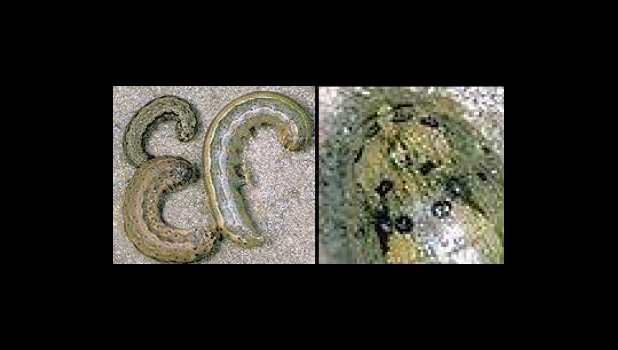
Time to scout for Fall Armyworms
Tue, 08/12/2025 - 1:57pm
admin
Agronomists in southwest Missouri and northern Arkansas report sightings of fall armyworms in grass and legume crops.
Fall armyworms do not overwinter in Missouri and migrate northward from Gulf Coast states. They damage forages by eating through the tender top leaf layer and leaving holes. Infested fields may appear drought damaged.
Armyworms march quickly into lush, green pastures and fields, so regular scouting is necessary. They feed on hundreds of host plant species, including tall fescue and alfalfa.
Fall armyworms do not feed during the heat of the day, so scout in early morning or evening. Look for bird or other predator activity, which is an indicator of infestation.
To scout for fall armyworm, select 10 random locations in a field and look for larvae in a 1-square-foot area at each location. If you find three or more half-inch larvae per square foot, consider chemical control or early harvest. Larvae more than 1.5 inches long are close to pupation, so chemical control may not be warranted.
Fall armyworms resistant to pyrethroids were discovered in Arkansas and Missouri. If chemical control is warranted, use a different chemical class to manage fall armyworm.
A safer and more sure way to control them with a longer residual would be to use products containing
chlorantraniliprole (Prevathon, Elevest, Vantacor, Besiege). Follow all label precautions and restrictions. Contact your local MU Extension agronomist for more information.
The University of Missouri Extension’s Pest Monitoring Network offers free, timely pest alerts to farmers and gardeners.
Early detection allows farmers to take quick action before infestations become severe. By scouting and monitoring their fields, farmers can make management decisions to prevent yield loss and reduce pesticide use.
Extension field agronomists and faculty across the state begin setting traps in March. They then submit data weekly to the MU Integrated Pest Management website (https://ipm.missouri.edu). Data highlights abundance and distribution of insect pests captured in the traps.
MU Extension sends alerts through text messages, email and mobile apps when a certain number of insects are captured over a period of seven days. Scouting, identification and other important information is at https://ipm.missouri.edu/pestMonitoring.