
Troop G – 80 Years Old This Month
Tue, 09/08/2026 - 12:27pm
admin
By:
Lou Wehmer
During the summer of 1946, a red flashing light appeared on the northern horizon above Willow Springs. This was significant in a time prior to the ubiquitous cellular/microwave towers dotting our Ozark skyline today. This light, the one on top of the Missouri State Highway Patrol tower, has flashed continuously for over eighty years this month. It has always been my night light in the sky. As a kid, I could see it from my yard on High Street in the 1950s until I left home in 1974. Returning from family travels to the north, I viewed the light as a waypoint at night, telling me that several miles away I was nearing home. It could and can be seen from a great distance, rising three hundred fifty feet above the higher elevation at the north end of Willow Springs. It was my work home for thirty-two years.
With World War over, equipment enabling effective two-way radio using frequency modulation was available for civilian use. An effort was initiated to upgrade the Patrol communications system. Previously, officers monitored an AM broadcast station in Jefferson City and responded by calling their office. A search began in the late 1930s for the best locations in the state for suitable radio towers, with consideration given to locations where state land was available.
Through the generosity of the Charles Ferguson family of Willow Springs, land was leased to the Missouri Highway Patrol in perpetuity at no cost. A member of the prestigious Highway Commission, Ferguson had years earlier been instrumental in securing a State Highway Department Headquarters in Willow Springs.
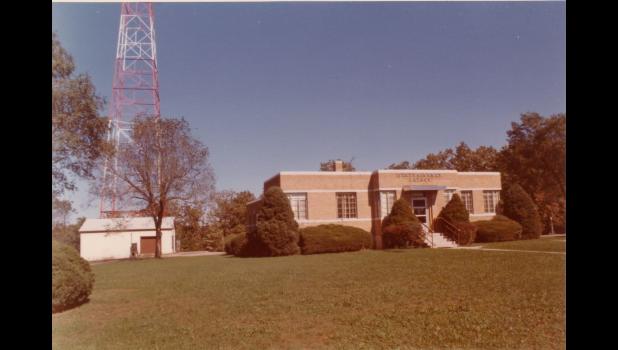
In August 1946, Troop G was established. A small concrete block building was erected to serve as a headquarters radio station with a small administrative office. Original secretary Doris Alsup recalled, “There was enough room for three desks and the radio equipment, and not much else.” The first troop meeting with Colonel Waggoner was held outdoors.
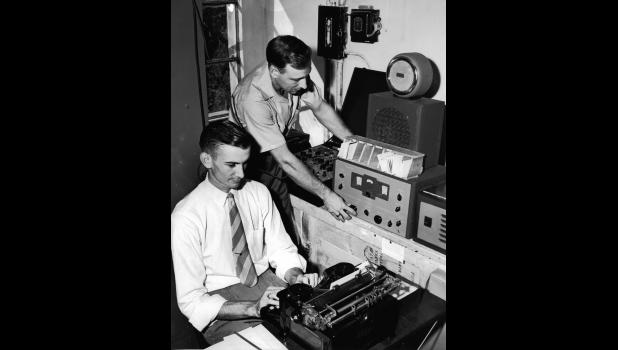
In addition to FM two-way equipment, a high-power short-wave station was installed, allowing statewide and national communication via Morse code. A teletype machine connected to a telephone line was also installed. It was necessary to hire or transfer communications personnel to run the new station. The senior operator, who was appointed Chief Operator at the new station, was Charles O. “Axe” Alexander, a veteran telegrapher who had been in the Patrol since 1937. All of the operators were required to be fluent and licensed in Morse code.
State Patrol Colonel Hugh Waggoner told the Willow Springs News on September 20, 1946, that, “four radio operators will be located here and that the station will be open 24 hours daily. The department also plans to increase the personnel of the Highway Patrol in this area during the next year, making this a troop headquarters. Willow Springs was selected as the site for the station when a survey made by the patrol showed it to be the most suitable location to serve the purpose needed. The station will provide better communication for members of the patrol and will enable this department to better serve the people. It will also be a fine asset to this community, one of which we may well be proud.” The men worked twelve hour shifts continuously with only a weekend a month off.
Earlier, in August five new troopers were assigned to help staff the new troop. The Willow Springs News reported the men, then in training at the Cuivre River camp in Troy, Missouri, were: “Ferial Alexander Findley, Puxico; Luke Holman, Jr., Lebanon; Jimmie Howard, Camdenton; Raymond W. Schunemeyer, Union; David Lavern Walker, West Plains. The disposition of officers already working the area to become Troop G was reported in the same issue: “Sergeant Ted Taylor of the local zone office of the State Highway Patrol will become a lieutenant on August 15. The promotion comes to Taylor after eleven years of service in the patrol’s Willow Springs office. He joined the organization on July 1, 1935, when Sergeant Nathan Massey headed the local zone office. With Massey was Trooper Ben Graham, and the troop headquarters was at Sikeston.”
The Willow Springs News continued, “Later Sergeant Howard J. Turnbull was placed over the local office and personnel was made up of Trooper Clyde Brill, Trooper Earl Barkley, Troopers Jack Pritchard and (Ted) Taylor. In January, 1942, Sergeant Turnbull was transferred to Troop F in Jefferson City, where he was made second-in-command. At that time, Taylor was promoted to Sergeant and placed in charge here. Brill and Barkley were stationed at West Plains and Mountain Grove but remained under the local zone office. To the average Willow Springs resident, the promotion of Taylor is taken as a matter of personal accomplishment. Although a native of Cabool, he is looked upon as a local resident because before joining the patrol he was employed here by the state highway division and Standard Oil for a number of years.”
Radio Operator Glenn R. Barnett wrote of his career: he was notified of his employment as a radio operator on July 25, 1946, hired specifically to work at the new station. At that time, he was told to report for duty six days later at Troop D Springfield for training and to remain there until the new station was ready, which was about a month later. Glenn served the remainder of his career, some 41 years, in Troop G, retiring as Chief Operator.
Also transferring to the new troop to man the communications facility was Russell O. Trimble. “Russ” had been with the Patrol since 1943. He had been allowed to join the Radio Division before his twenty-first birthday due to a shortage of radio telegraphers during World War II. He was a victim of polio as a child and could not serve in the military. Russell was promoted to Chief Operator of Troop G in 1951.
While the headquarters building was being constructed, a secretary and the commanding officer worked out of an office in the basement of the Missouri Highway Department garage nearby. A telephone was unavailable, and for several months the Troop Commander had to drive up the hill to the construction site, where a single telephone had been installed. That line, connected to a single telephone, became the public number for Troop G, manned twenty-four hours, number 110. Captain Tandy later recalled that in those early days he and the troop lieutenant often served as desk officer.
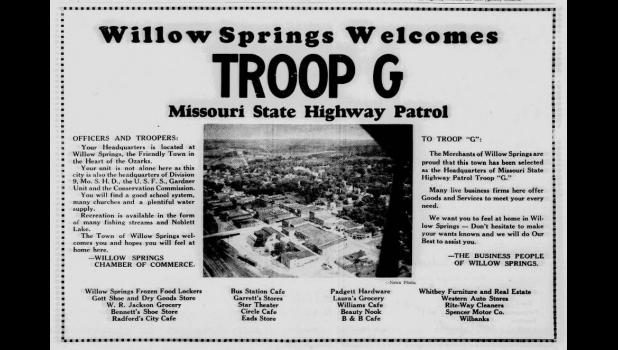
On September 19, 1946, the Willow Springs News published a special edition calling attention to the official dedication of the troop and welcoming the personnel of Troop G. At that time, the troop consisted of seventeen officers, serving a thirteen-county area.
The new troop was staffed by 16 officers, half of whom were assigned to the northern tier of counties along U.S. Route 66. When Troop I, Rolla, was formed in 1949, Pulaski, Phillips, Camden, Dent, and Laclede Counties were dropped from Troop G, and Carter County was taken from Troop E and added to the Troop G service area. These changes reflect present-day Troop G encompassing nine counties and a 7,547 square mile area.
The new Troop Headquarters building was constructed in 1951 to accommodate growth of the troop, housing administrative offices, a radio communications center, an evidence laboratory, and a troop meeting room. The previous headquarters building, located at the foot of the 350-foot radio tower, was retained as a “doghouse” for radio transmitting and receiving equipment, an emergency generator, and a maintenance shed. It was inconceivable at the time that the troop would ever outgrow its new home.
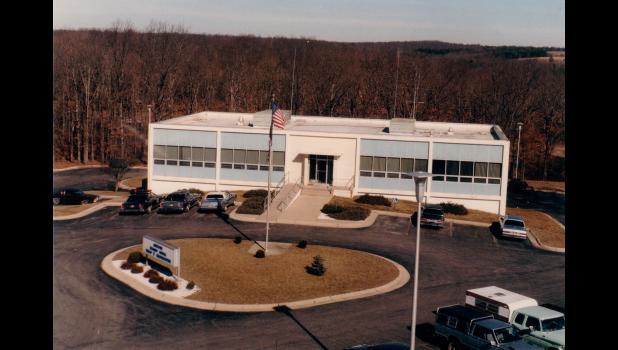
However, time marches on, and bids were opened in June 1973 for new headquarters facilities at Troop G and Troop E in Poplar Bluff. Construction of a new Troop G Headquarters building began in November 1973. Bad weather during winter and spring delayed progress, but the building was finally under roof in September 1974. Captain W.L. Hutchings was quoted as saying, “It will be nice to hold a troop meeting and have everyone seated in the same room.” It was a long way from the first troop meeting held in the parking lot of a headquarters not yet constructed.
I spent 32 years at the new Troop G Headquarters, starting in 1975 after transferring there from Troop E in Poplar Bluff, where I had worked for a year. I retired as Chief Telecommunications Engineer in 2007 and I remain impressed with the caliber of the men I worked with in my early years.
Many of my co-workers were original members who had served in military combat not many years before joining the patrol. In the room where I worked, Glenn Barnett served in the First Marine Division on a tank crew, as part of the forces landing on New Guinea, New Britain, Peleliu, and Okinawa, and in the occupation of Guadalcanal. He said the worst carnage was on Peleliu under extremely hot conditions.
On the front desk, Sergeant Jimmy Howard was eating breakfast in an Army mess hall at Pearl Harbor when a Japanese plane machine-gunned the building he was in. From there Jimmy dug a foxhole on the beach waiting for an invasion that did not come. From there Jimmy went into combat at Guadalcanal, as he put it, “to rescue the Marines like Barnett.” He liked to call my fellow operator Woody Mitchell, “Flower Sack” because of his white uniform.
Woody, who had been in a CCC (Civilian Conservation Corp Camp) during the Depression, joined the United States Navy at the start of World War II, serving as a skilled radio-telegrapher onboard a number of combat vessels, rising to the rank of Communications Chief. The latter part of his time in the War was spent onboard the light aircraft carrier Belleau Wood. His ship participated in several battles, was struck by a Kamikaze - killing 92 men, and fought in the Battle of Leyte Gulf, during Woody’s tenure aboard.
I know the community I’ve lived in all my life has greatly benefited financially by the presence of the State Patrol headquarters in town and the caliber of the people it has employed there for over eighty years.
During my tenure as chief, the original 1946 tower was downed by a tornado and immediately replaced with a new tower. For me that blinking light at the north end of Willow Springs reminds me of the ongoing legacy of service to our communities by the personnel of Troop G.